 |
 |
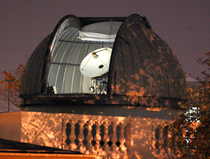 The 1.2 meter telescope at CfA
|
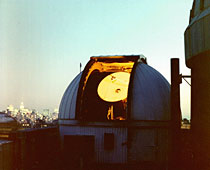
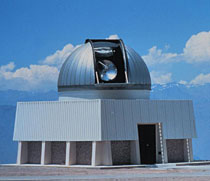
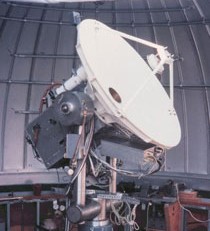
"Surveys aren't the most important thing in astronomy – they're the only thing." ---J. Ostriker Introduction The 1.2 meter Millimeter-Wave Telescope at the CfA has been studying the distribution and properties of dense, star-forming molecular clouds in our Galaxy and its nearest neighbors for over three decades. Built by Prof. Patrick Thaddeus and colleagues in 1974, the telescope was operated from a Columbia University rooftop overlooking the Manhattan skyline for over 10 years before being moved to the CfA in 1986. A twin instrument was constructed at Columbia and shipped to Cerro Tololo, Chile in 1982. Together, these two instruments have obtained what is by far the most extensive, uniform, and widely-used Galactic survey of interstellar carbon monoxide (CO), the best general tracer of the largely invisible molecular hydrogen that constitutes most of the mass in molecular clouds. A total of 24 PhD dissertations have so far been written based on observations or instrumental work with these telescopes, and many more undergraduate students at Columbia and Harvard have participated in the observations either in course laboratories (currently Astro 191 and Astro 17) or as observing assistants (currently Daniel Henderson and David Paiva). Major Scientific Achievements Designed and constructed in-house by our research group just a few years after the first detection of CO in space (Wilson, Jefferts, & Penzias 1970), the 1.2 meter telescope has played an important or dominant role in all of the important general findings on molecular clouds (MCs) listed below. Many of these are now considered conventional wisdom but some were originally very controversial (e.g., the very existence of giant molecular clouds, their ages, and their confinement to spiral arms).
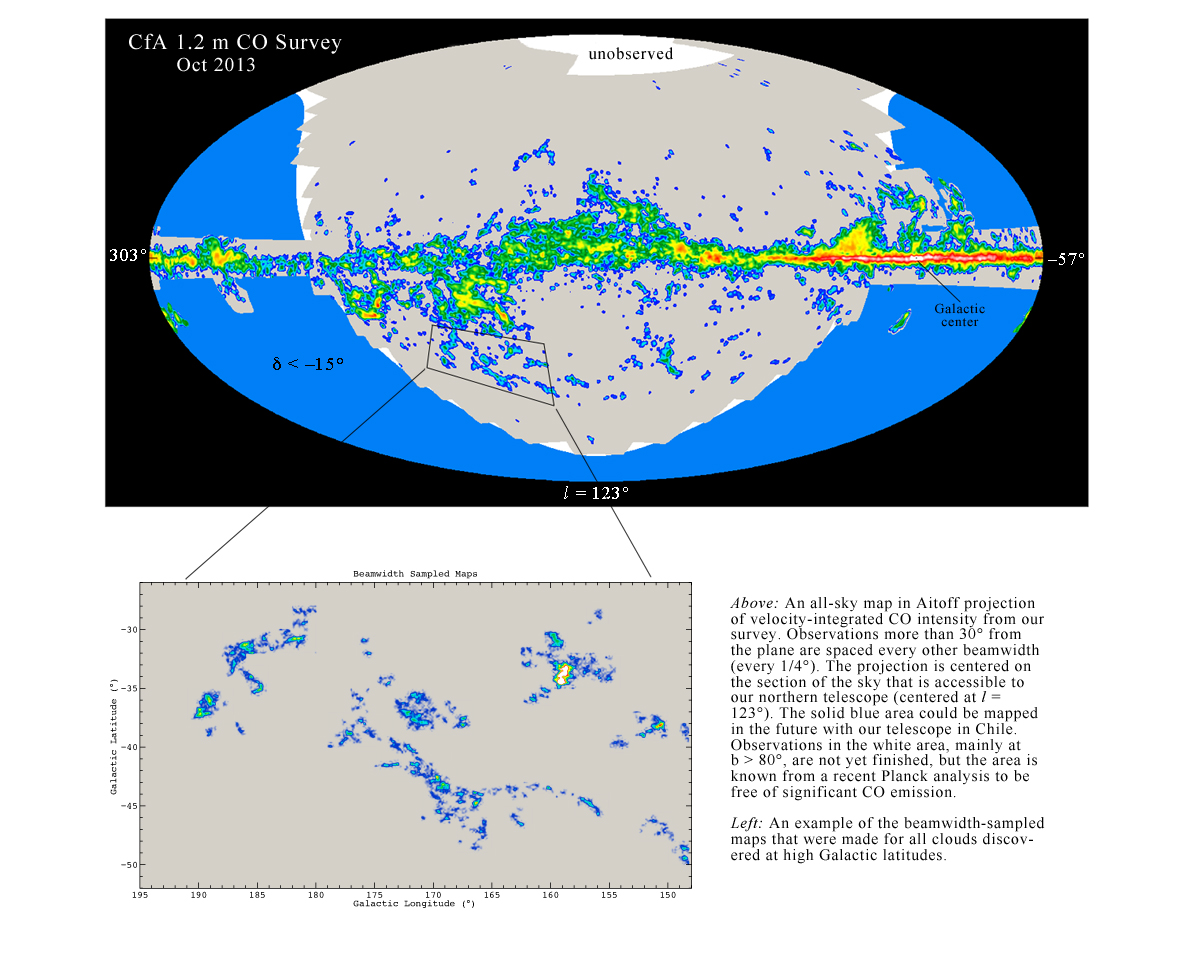
Because molecular clouds are so large, contain such a large fraction of the interstellar gas and dust, and are the source of so many conspicuous young objects, we and our CO surveys have long played an important role in interpreting the Galactic emission in every major wavelength band. Our CO survey has been essential to the analysis of a number of very large and expensive satellite projects, including most recently those of the Fermi Gamma Ray Space Telescope and Planck. Current Research Over the past few years a major goal of the 1.2 meter telescope has been compleion of a survey of the entire northern sky lying outside the sampling boundary of the composite CO survey of Dame et al. (2001). As of June 2013 this survey is nearly complete, consisting of over 375,000 spectra and covering ~24,000 sq-deg with 1/4° sampling. In addition, all molecular clouds at |b| > 10° and dec > –15° (~248) have been mapped every beamwidth. In 2011, Dame & Thaddeus found clear evidence in existing 21 cm surveys for a large extension of the Scutum-Centaurus spiral arm, one of the two major spiral arms thought to extend from the ends of the Galactic bar. The "Outer Sct-Cen arm" lies well beyond the solar orbit on the far side of the Galaxy, roughly 21 kpc from the Sun. The CfA 1.2 m telescope has so far detected 22 distinct giant molecular clouds associated with H I peaks in the arm, and a large, unbiased CO survey of the entire arm was begun in the fall of 2013; it is expected to require ~2 years to complete. |