Contacts
|
CfA Home
|
HCO Home
|
SAO Home
|
Intranet
About
|
Research
|
Education & Outreach
|
Facilities
|
Opportunities
|
Events
|
Press Room
Resources for . . .
Scientists
Software Users
The Public
Educators & Students
Amateur Astronomers
CfA Staff (Intranet)
Scott's Home Page
Research
Planet Formation
Star Formation
Symbiotic Stars
Galaxies
Publications
Astro-ph
Journals
SAO Links
TAC
GMT
SSP Division
Coagulation Code for Planet Formation
Coagulation is growth by collision and merger
Statistical approach to inelastic collisions
Fragmentation algorithm for collision outcomes
Fokker-Planck approach to elastic collisions
Coagulation codes have several advantages
Essential for 10
15
or more planetesimals
Calculate evolution of small planets accurately
Calculate collisional cascade
Coagulation codes also have some disadvantages
Fail when most of the mass in a few large objects
Cannot predict final mass of planet
Cannot model formation of gas giant planets
Multiannulus particle-in-a-box method
Treats planetesimals as statistical ensemble
Particles in all annuli interact
Fragmentation + Gas drag + Poynting-Robertson drag
Code is parallel to run on modern supercomputer
We also calculate the evolution of dust grains
Separate treatment of small particles
Synthesize luminosity evolution and model images
We have extensively tested the code
Code reproduces previous published results
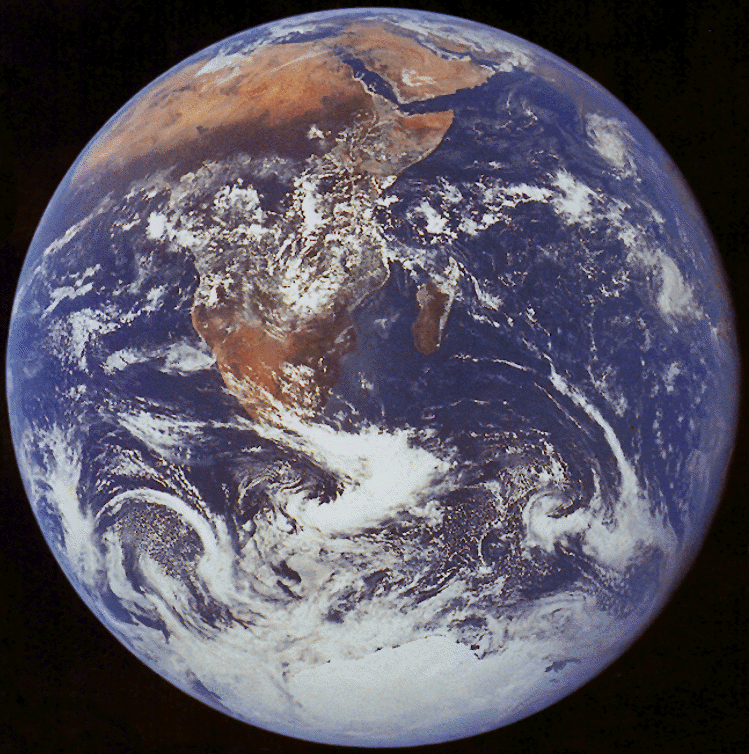
We used the bybrid code to calculate the formation of Earth-like planets.
Learn more ...
About
|
Research
|
Education & Outreach
|
Facilities
|
Opportunities
|
Events
|
Press Room
|
Contacts
|
Support CfA
|
Privacy
HARVARD-SMITHSONIAN CENTER FOR ASTROPHYSICS | 60 GARDEN STREET | CAMBRIDGE, MA 02138