
- Eric Keto's Home Page
- High Mass Stars
- Starless Cores
- Extragalactic
- Radiative Transfer
- Hydrodynamics
- SMA Instrumentation
- IR Instrumentation
- MOLLIE radiative transfer
- Keto Prize
- Textbooks
 |
|
|
|
|
|
The Structure and Evolution of Star Forming Clouds
| ||||
|
Abstract Low-mass stars are generally understood to form by the gravitational collapse of the dense molecular clouds known as starless cores. Continuum observations have not been able to distinguish among the several different hypotheses that describe the collapse because their predicted density distributions are the almost the same, as they are for all spherical self-gravitating clouds. However, the predicted radial profiles of the contraction velocity are different enough that the models can be discriminated by comparing the inward velocities at large and small radii. This can be done by observing at least two different molecular line transitions that are excited at different densities. For example, the spectral lines of the H2O (110 - 101) and C18O (1-0) have critical densities for collisional de-excitation that differ by 5 orders of magnitude. We compare observations of these lines from the contracting starless core L1544 against the spectra predicted for several different hypothetical models of contraction including the Larson-Penston flow, the inside-out collapse of the singular isothermal sphere, the quasi-equilibrium contraction of an unstable Bonnor-Ebert sphere, and the non-equilibrium collapse of an over-dense Bonnor-Ebert sphere. Only the model of the unstable quasi-equilibrium Bonnor-Ebert sphere is able to produce the observed shapes of both spectral lines. This model allows us to interpret other observations of molecular lines in L1544 to find that the inward velocities seen in observations of CS(2-1) and N2H+ are located within the starless core itself, in particular in the region where the density profiles follows an inverse square law. If these conclusions were to hold in the analysis of other starless cores, this would imply that the formation of hydrostatic clouds within the turbulence of the interstellar medium is not only possible but not exceptional and may be an evolutionary phase in low-mass star formation. Eric Keto, Jonathan Rawlings, and Paola Caselli, 2014, MNRAS in press
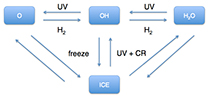
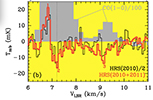
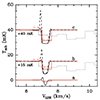
Abstract The Herschel Space Observatory's recent detections of water vapor in the cold, dense cloud L1544 allow a direct comparison between observations and chemical models for oxygen species in conditions just before star formation. We explain a chemical model for gas phase water, simplified for the limited number of reactions or processes that are active in extreme cold (< 15 K). In this model, water is removed from the gas phase by freezing onto grains and by photodissociation. Water is formed as ice on the surface of dust grains from O and OH and released into the gas phase by photodesorption. The reactions are fast enough with respect to the slow dynamical evolution of L1544 that the gas phase water is in equilibrium for the local conditions thoughout the cloud. We explain the paradoxical radiative transfer of the H2O (110-101) line. Despite discouragingly high optical depth caused by the large Einstein A coefficient, the subcritical excitation in the cold, rarefied H2 causes the line brightness to scale linearly with column density. Thus the water line can provide information on the chemical and dynamical processes in the darkest region in the center of a cold, dense cloud. The inverse P-Cygni profile of the observed water line generally indicates a contracting cloud. This profile is reproduced with a dynamical model of slow contraction from unstable quasi-static hydrodynamic equilibrium (an unstable Bonnor-Ebert sphere). Eric Keto, Jonathan Rawlings, and Paola Caselli, 2014, MNRAS, 440, 2616
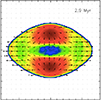
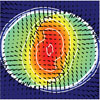
Abstract Long wavelength sonic oscillations are observed or inferred in many of the small, dark molecular clouds, the starless cores, that are the precursors to protostars. The oscillations provide significant internal energy and the time scale for their dissipation may control the rate of star formation in starless cores. Despite their importance, their origin is unknown. We explore one hypothesis that the oscillations develop as a starless core forms from a filament. We model this process with a numerical hydrodynamic simulation and generate synthetic molecular line observations with a radiative transfer simulation. Comparison with actual observations shows general agreement suggesting the proposed mechanism is viable. Eric Keto and Andreas Burkert, 2014, MNRAS 441, 1468
Abstract Water is a crucial molecule in molecular astrophysics as it controls much of the gas/grain chemistry, including the formation and evolution of more complex organic molecules in ices. Pre-stellar cores provide the original reservoir of material from which future planetary systems are built, but few observational constraints exist on the formation of water and its partitioning between gas and ice in the densest cores. Thanks to the high sensitivity of the Herschel Space Observatory, we report on the first detection of water vapor at high spectral resolution toward a dense cloud on the verge of star formation, the pre-stellar core L1544. The line shows an inverse P-Cygni profile, characteristic of gravitational contraction. To reproduce the observations, water vapor has to be present in the cold and dense central few thousand AU of L1544, where species heavier than helium are expected to freeze out onto dust grains, and the ortho:para H2 ratio has to be around 1:1 or larger. The observed amount of water vapor within the core (about 1.5E-6 solar masses) can be maintained by far-UV photons locally produced by the impact of galactic cosmic rays with H2 molecules. Such FUV photons irradiate the icy mantles, liberating water vapor in the core center. Our Herschel data, combined with radiative transfer and chemical/dynamical models, shed light on the interplay between gas and solids in dense interstellar clouds and provide the first measurement of the water vapor abundance profile across the parent cloud of a future solar-type star and its potential planetary system. Paola Caselli, Eric Keto et al., 2012, ApJL 759, L37
Abstract Previous studies by the satellites SWAS and Odin provided stringent upper limits on the gas phase water abundance of dark clouds (x(H2O) < 7 E-9). We investigate the chemistry of water vapor in starless cores beyond the previous upper limits using the highly improved angular resolution and sensitivity of Herschel and measure the abundance of water vapor during evolutionary stages just preceding star formation. Methods. High spectral resolution observations of the fundamental ortho water (o-H2O) transition (557 GHz) were carried out with the Heterodyne Instrument for the Far Infrared onboard Herschel toward two starless cores: Barnard 68 (hereafter B68), a Bok globule, and LDN 1544 (L1544), a prestellar core embedded in the Taurus molecular cloud complex. Detailed radiative transfer and chemical codes were used to analyze the data. Results. The RMS in the brightness temperature measured for the B68 and L1544 spectra is 2.0 and 2.2 mK, respectively, in a velocity bin of 0.59 km s-1. The continuum level is 3.5 +- 0.2 mK in B68 and 11.4 +- 0.4 mK in L1544. No significant feature is detected in B68 and the 3 sigma upper limit is consistent with a column density of o-H2O N(o-H2O) < 2.5 E13 cm-2, or a fractional abundance x(o-H2O) < 1.3E-9, more than an order of magnitude lower than the SWAS upper limit on this source. The L1544 spectrum shows an absorption feature at a 5$\sigma$ level from which we obtain the first value of the o-H2O column density ever measured in dark clouds: N(o-H2O) = (8 +- 4) E12 cm-2. The corresponding fractional abundance is x(o-H2O) ~ 5E-9 at radii >7000 AU and toward the center. The radiative transfer analysis shows that this is consistent with a x(o-H2O) profile peaking at $\simeq$10-8, 0.1 pc away from the core center, where both freeze-out and photodissociation are negligible. Conclusions. Herschel has provided the first measurement of water vapor in dark regions. Column densities of o-H2O are low, but prestellar cores such as L1544 (with their high central densities, strong continuum, and large envelopes) appear to be very promising tools to finally shed light on the solid/vapor balance of water in molecular clouds and oxygen chemistry in the earliest stages of star formation. Paola Caselli, Eric Keto et al., 2010, A&A 521, L29
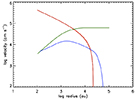
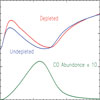
Abstract In previous studies we identified two classes of starless cores, thermally subcritical and supercritical, distinguished by different dynamical behavior and internal structure. Here we study the evolution of the dynamically-unstable, thermally-supercritical cores by means of a numerical hydrodynamic simulation that includes radiative equilibrium and simple molecular chemistry. From an initial state as an unstable Bonnor-Ebert (BE) sphere, a contracting core evolves toward the configuration of a singular isothermal sphere (SIS) by inside-out collapse.We follow the gas temperature and abundance of CO during the contraction. The temperature is predominantly determined by radiative equilibrium, but in the rapidly contracting center of the core, compressive heating raises the gas temperature by a few degrees over its value in static equilibrium. The time scale for the equilibration of CO depends on the gas density and is everywhere shorter than the dynamical timescale. The result is that the dynamics do not much affect the abundance of CO which is always close to that of a static sphere of the same density profile, and CO cannot be used as a chemical clock in starless cores. We use our non-LTE radiative transfer code MOLLIE to predict observable CO and N2H+ line spectra, including the non-LTE hyperfine ratios of N2H+, during the contraction. These are compared against observations of the starless core L1544. The comparison indicates that the dust in L1544 has an opacity consistent with ice-covered rather than bare grains, the cosmic ray ionization rate is about 1E-17 s-1, and the density structure of L1544 is approximately that of a Bonnor-Ebert sphere with a maximum central density of 2E7 cm-3, equivalent to an average density of 3E6 cm-3 within a radius of 500 AU. The observed CO line widths and intensities are reproduced if the CO desorption rate is about 30 times higher than the rate expected from cosmic-ray strikes alone, indicating that other desorption processes are also active. Eric Keto & Paola Caselli, 2010, MNRAS 402, 1625
Abstract Previous observations and theoretical models of starless cores suggest that the different temperature and density structures observed in individual cores and their different dynamical behaviors can be described by a consistent set of physics. Here we develop a model for the thermal and dynamical equilibrium of starless cores that includes the radiative transfer of the gas and dust, and simple CO chemistry. The model shows that the behavior of the cores is significantly different depending on whether the central density is either above or below about 1E5 cm-3. This is close to the critical density for both gas cooling by gas-dust collisions and also for dynamical stability, given the typical properties of the starless cores. Thus the model divides the starless cores into two classes that we refer to as thermally super-critical and thermally sub-critical. This simple model allows an improved interpretation of observational data to better understand the evolution of starless cores, their dust opacity, and the rate of cosmic-ray ionization that heats them. Eric Keto & Paola Caselli, 2008, ApJ 683, 238
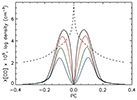
Abstract In a previous paper, we modeled the oscillations of a thermally-supported (Bonnor-Ebert) sphere as non-radial, linear perturbations following a standard analysis developed for stellar pulsations. The predicted column density variations and molecular spectral line profiles are similar to those observed in the Bok globule B68 suggesting that the motions in some starless cores may be oscillating perturbations on a thermally supported equilibrium structure. However, the linear analysis is unable to address several questions, among them the stability, and lifetime of the perturbations. In this paper we simulate the oscillations using a three-dimensional numerical hydrodynamic code. We find that the oscillations are damped predominantly by non-linear mode-coupling, and the damping time scale is typically many oscillation periods, corresponding to millions of years, and persisting over the inferred lifetime of gobules. Avery E. Broderick, Eric Keto, Charles J. Lada & Ramesh Narayan, 2007, ApJ, 671, 1832
Abstract If the split, asymmetric molecular spectral line profiles that are seen in many starless cores are interpreted as indicative of global collapse or expansion of the core then one possible implication is that most starless cores have short lifetimes on the order of the collapse or sound crossing time scale. An alternative interpretation of the line profiles as indicative of perturbations on an underlying equilibrium structure leads to the opposite implication, that many cores have long lifetimes. While evidence suggests that some cores are collapsing on a free-fall time scale, we show that observations of some other starless cores can be reproduced by a model of non-radial oscillations about the equilibrium configuration of a pressure-bounded, thermally-supported sphere (Bonnor-Ebert sphere). We model the oscillations as linear perturbations following a standard analysis developed for stellar pulsations and compare the column densities and molecular spectral line profiles predicted from a particular model to observations of the Bok globule B68. Eric Keto, Avery E. Broderick, Charles J. Lada & Ramesh Narayan, 2007, ApJ, 652, 1366
Abstract We test the hypothesis that the starless cores may be gravitationally bound clouds supported largely by thermal pressure by comparing observed molecular line spectra to theoretical spectra produced by a simulation that includes hydrodynamics, radiative cooling, variable molecular abundance, and radiative transfer in a simple one-dimensional model. The results suggest that the starless cores can be divided into two categories: stable starless cores that are in approximate equilibrium and will not evolve to form protostars, and unstable pre-stellar cores that are proceeding toward gravitational collapse and the formation of protostars. The starless cores might be formed from the interstellar medium as objects at the lower end of the inertial cascade of interstellar turbulence. Additionally, we identify a thermal instability in the starless cores. Under particular conditions of density and mass, a core may be unstable to expansion if the density is just above the critical density for the collisional coupling of the gas and dust so that as the core expands the gas-dust coupling that cools the gas is reduced and the gas warms, further driving the expansion. Eric Keto & George B. Field, 2005, ApJ, 635, 1151
| |||

|