|
|
|
|
|
| Dr. Justin C. Kasper - Biography | Featured Topic | |||
|
Click here for
a copy of my Curriculum Vitae.
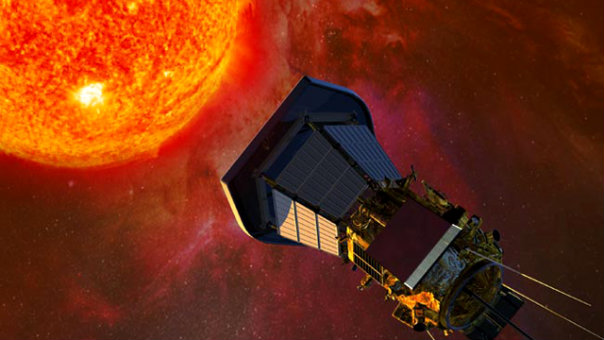
I was born in North Tarrytown (now Sleepy Hollow), NY and grew up in Ossining, NY. I graduated from Ossining High School. I received my undergraduate degree in Physics with Special Honors from the University of Chicago in 1999. For the four years I was in Chicago I worked for Professor John Simpson in his Cosmic Ray Group at the Laboratory for Astrophysics and Space Research (LASR) in the Enrico Fermi Research Institute. As a student data analyst, my main responsibilities were the production of cosmic ray data from the Ulysses High Energy Telescope and the archiving of existing data. My senior thesis was on measurements of the flux of the rare elements lithium, beryllium, and boron during solar energetic particle events. I had a great time working at LASR and learned a great deal about the physics of the heliosphere and the scientific process in general from Prof. Simpson and other members of his group, including Drs. Clifford Lopate, Bruce Mckibben, and Jim Connell, now all at the University of New Hampshire, and from Ming Zhang, now at Florida. I moved to Cambridge in July of 1999. That fall I began my doctoral work in the Astrophysics division of the Physics Department at the Massachusetts Institute of Technology. I spent that first summer starting work with Drs. Alan Lazarus and Matthias Aellig on the Faraday Cup instrument for the Triana spacecraft. The Triana Faraday Cup is a beautiful instrument, if I do say so. We took advantage of the fact that the spacecraft was three-axis stabilized and Sun-pointing to build an instrument that could measure the bulk characteristics of the hydrogen and helium distribution functions at a rate of about 2 Hz. A conceptual design for the instrument was in place and I soon found myself at NASA Goddard Space Flight Center conducting beam tests with Drs. Keith Ogilvie and Dennis Chornay. My doctoral thesis focused on long-term observations of the solar wind collected by the twin Faraday Cup ion instruments on the Wind spacecraft. I discovered that with the large number of measurements of the solar wind collected by Wind since launch in 1994 I could construct powerful constraints on the roles of plasma instabilities and other non-thermal processes in the solar wind. My doctoral thesis compared theoretical predictions for instabilities and shocks with observations, producing among other things the first demonstration of the firehose instability. After I defended that December I quickly submitted the final copy of my thesis and took an appointment as a postdoctoral researcher at the MIT Center for Space Research (now the Kavli Institute for Astrophysics and Space Research). I jumped on an opportunity to teach 8.02T, an undergraduate electricity and magnetism course, for the physics department that Spring. 8.02T is a product of the Technology Enabled Active Learning (TEAL) program developed by Prof. John Belcher I had followed the development of the TEAL program over the previous two years, and was a TA for John in an experimental version of the course in 2002. I won't try to summarize the philosophy of the TEAL program here, but I believe that it is the most effective way to teach large groups conceptually challenging fields such as electricity and magnetism. One of the most rewarding aspects of my time at MIT was been interacting with amazing students. In addition to teaching electricity and magnetism, I supervised the research of fourteen undergraduates and one graduate student. In the Spring of 2004 I received the Dean's Award for Teaching and Student Advising from the Dean of Sciences at MIT. One year later, in 2005 I became a Research Scientist at the MIT Kavli Institute for Astrophysics and Space Research. In 2007 I accepted an offer to move to the Harvard-Smithsonian Center for Astrophysics and join the Solar and Stellar X-Ray Group, where I continue my work on particle and field experiments in space, along with new work on remote imaging telescopes. My main project is the Solar Wind Electrons Alphas and Protons (SWEAP) Investigation for the NASA Solar Probe Plus Mission. More information about specific projects can be found on my main page. |
On the Radio: The Breathtaking Power And Beauty Of The Sun The science, destruction, and beauty of the solar storm that's been blasting earth - from the breathtaking Aurora Borealis to future exploration of the sun itself. I was a guest for a one hour episode of WBUR talk show On Point with Tom Ashbrook. Stream the show and read background material on the Sun here. --- NASA Science News: Solar Wind Energy Source Discovered NASA wrote a news story based on a recent paper we published in Physical Review Letters on heating of the solar corona and solar wind. Click here for the NASA article. | ||